Dive into the fascinating world of Amber, a fossil resin with golden hues. Explore its age-old history, its...
Sunstone: History, Origin, Composition, Virtues, Meaning and Recharging of the stone
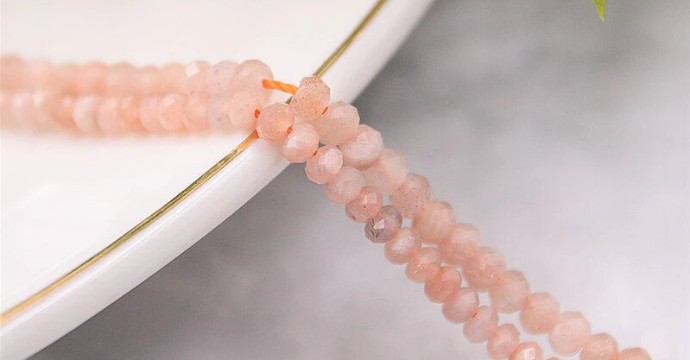
Sunstone comes from the Feldspar family. It is a unique natural stone with sparkling reflections, known as Aventurescence. Sunstone is known the world over for its beauty and soft pink to orange hues, sometimes green, yellow or brown. This natural stone is very popular in lithotherapy for its relaxing and protective properties, as well as in the world of jewelry.
History of Sunstone
The name Sunstone was given this name by a French mineralogist, Jean-Claude Delaméthérie, in 1801. Before it was given this name, the stone was called Heliolite, in reference to the Greek sun god, Helios.
The Greeks wore the stone as a bracelet or other jewelry to bring prosperity, good fortune and longevity.
Sunstone has reflected the centuries, civilizations and legends. Since time immemorial, this magnificent natural pinkish-orange stone has lulled people to sleep, as it did the Vikings in ancient times, who worshipped Sunstone. In Viking legend, it is said that the gates of Valhalla were accessible to those holding a Sunstone.
A hypothesis was drafted in 1967 by archaeologist Thorkild Ramskou, stating that a Sunstone was found on a ship and used as a compass for orientation at sea. This hypothesis asserts that by placing the stone in front of one's eye, it was possible to track the position of the sun, and that the Vikings left it as a legacy.
The Egyptians used stone in rituals to protect themselves from curses and wore it as talismans.
Among the Celts, Sunstone was associated with cosmic light.
For Buddhists, this natural stone was linked to Vishnu, the Hindu god and protector of the universe. However, for some Indians, Sunstone is linked to Surya, the Hindu sun god, and can protect against curses.
In China, the stone was regarded as the imperial sun.
Nowadays, it is possible to find Sunstone for jewelry or lithotherapy.
Origin and composition of Sunstone
Sunstone is a member of the Feldspar family. Sunstone has several compositions that can differ according to their feldspar types. If Sunstone is orthoclase, composed mainly of potassium, aluminum, silicon and oxygen, with the chemical formula KAlSi3O8. If Sunstone is oligoclase, its compositions can vary between its sodium content, which therefore has a chemical formula of NaAlSi3O8, or its calcium content, which therefore has a chemical formula of CaAl2Si2O8. Sunstone has a density of around 2.56 to 2.65.
Sunstone forms slowly in igneous rocks beneath the earth's surface from the crystallization of magma, and forms in metamorphic rocks due to pressure, heat and fluids.
It is possible to find various varieties of Sunstone due to impurities mixed in. The stone can have green, gray, brown or red shades, depending on the amount of copper, but also yellow to golden-brown aspects with goethite inclusions, or red to brown metallic reflections due to hematite.
Sunstone has, like Labradorite or Moonstone, a sparkling effect produced when light is used to form it. In the case of Sunstone, the phenomenon is called Aventurescence. This phenomenon offers a sparkling luminous effect which, thanks to the light reflecting off the metallic mineral inclusions, creates a glittering effect.
Origin of Sunstone
The world's leading Sunstone are Norway, the United States, Canada, India, Russia, Tanzania, Sri Lanka and Mongolia.
Sunstone has a hardness of around 6 to 7 on the Mohs scale.

Virtues and Significance of Sunstone in lithotherapy
In lithotherapy Sunstone is a stone of protection and comfort.
Sunstone in lithotherapy
Physically, Sunstone is a natural stone with numerous benefits for the body, including the reproductive and digestive organs and the immune system. These virtues stimulate the reproductive organs and the development of the sexual life, while reducing female intimate pain and erection problems. Sunstone not only improves blood circulation and keeps the body healthy, but also ensures that muscles such as the heart function properly. Last but not least, this stone relieves stomach aches and promotes transit to avoid bloated or distended tummies.
In lithotherapy, on the psychic level, Sunstone has naturally beneficial properties. It amplifies positive energies while protecting the user from negative energies, both internal (anxiety, sadness, worry...) and external (jealousy, anger...). Sunstone increases self-confidence, empathy and, above all, brings luck, happiness and better sleep.
Please note that lithotherapy is not a substitute for medical treatment or expertise.
Meaning of Sunstone
Sunstone is a symbol of vital force, good luck and good fortune.
It is associated with the solar plexus chakra, which enhances vitality, happiness and the strength to carry out projects. This chakra also improves digestive system function. Sunstone is also linked to the sacral chakra, which opens the mind, enhances creativity, joy of life and the connection between body and emotions. What's more, the sacral chakra is known to enhance the sex life.
Sunstone is associated with the astrological signs of Leo, Scorpio and Aries.
Maintenance, Purification and Recharging Sunstone
To take care of your Sunstone, we suggest a few methods:
Cleaning and Purifying Sunstone
It's important to know how to properly clean and purify your Sunstone:
- Clean with a slightly damp cloth to remove dirt,
- Place the stone in a bowl of distilled water for a short time to clean it,
- Purify by fumigation with purifying herbs such as sage, incense or palo santo wood,
- Bury Sunstone in the soil for a full day and wipe it clean with a soft cloth to remove any soil residue.
Reloading Sunstone
Don't forget the step of recharging Sunstone to take full advantage of its powers:
- Recharge with the sun's rays Sunstone appreciates and needs lots of sun,
- Place a cluster of quartz next to it to recharge it.