Dive into the fascinating world of Amber, a fossil resin with golden hues. Explore its age-old history, its...
Green Agate: History, Origin, Composition, Virtues, Meaning and Recharging of the stone
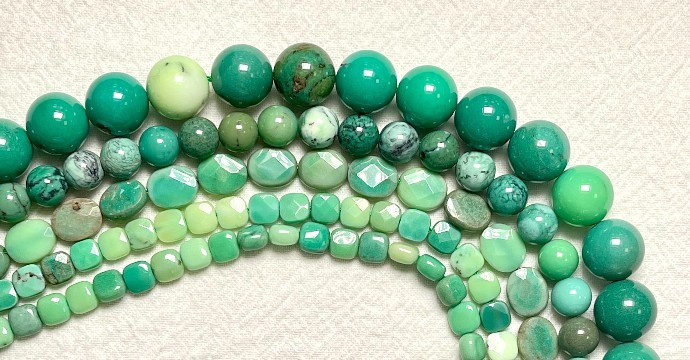
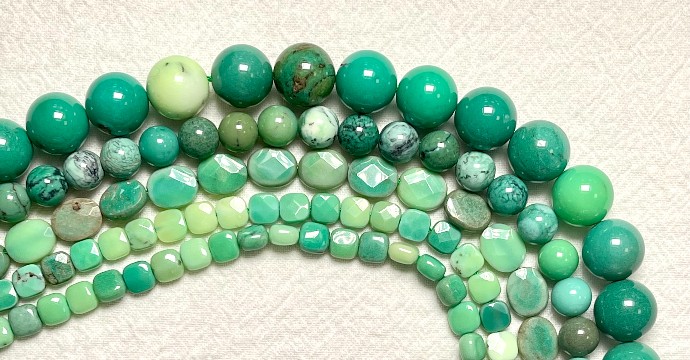
Green agate is a variety of Agate, itself a member of the large Chalcedony family. Green Agate covers a wide range of stones, including Moss Agate, Grass Agate, Peacock Agate, Dendritic Agate and many more.
History of Green Agate
The origin of the name Agate comes from the ancient Greek "Akhatês", the stone was named by Theophrastus, when he found it in Sicily in 300 BC, near the river formerly called "Achates" in Latin and now called Dirillo. The stone Green agate is a very ancient stone, discovered in antiquity and used for jewelry and decoration.
The Romans and Greeks used stone primarily for its beauty, but also for its healing properties. They used it as a talisman to protect themselves from disease, evil spirits or bad luck.
During the Middle Ages, Europeans used green Agate as a talisman against poverty and disease.
During the Renaissance, green agate was mainly used for ornamental purposes and jewelry.
Nevertheless, Green Agate has much the same history as Agate, so it is possible to find out more about its history and characteristics on this website article.
Various varieties of green Agate stones are known throughout the world as :
- Peacock agate is growing in popularity thanks to its iridescent colors, which resemble peacock feathers. Unfortunately, there aren't many stories about the stone. However, it is believed that the stone dates back to ancient civilizations and was used differently by each civilization. As protection, good luck charm, decoration and jewelry.
- Moss agate is known for its fibrous, moss-like inclusions. This ancient stone was first used by the Greeks for its healing and protective properties. Later, in the Middle Ages, it was considered to bring luck, good fortune and prosperity, and was used as a talisman. Today, it is used for spiritual purposes and in jewelry.
- Grass Agate is not yet well known in the jewelry world, and its color comes from inclusions of iron or manganese. It is not well documented, but it is thought to date back thousands of years and was used for its spiritual and physical healing properties. Later, grass agate was used for decorative purposes.
- Dendritic agate is characterized by brown to black inclusions that resemble branches or trees. This stone was already used in ancient times, including by the Greeks for its protective virtues. During the Middle Ages, it was mainly used for its soothing properties, such as stability and inner peace. Today, the stone is widely used in the world of jewelry and lithotherapy.

Origin and composition of Green Agate
Natural stone Green agate is a member of the large Chalcedony family. Its main composition is silicon dioxide (SiO2), with a few iron inclusions that give it its green color. Its density is around 2.64, although it can vary depending on the Agate species.
Agates are formed on and/or within pre-existing low-temperature rocks and are often located in cavities in volcanic rocks. These cavities are formed by gases trapped inside volcanic fluids. The hydrothermal fluids trapped inside these cavities crystallize and form Agate.
The color of Green agate may vary from country to country, for example :
- Brazil has some very beautiful dark green Agates with a ribboned pattern,
- India is known for its lighter colors and sharper patterns,
- the United States offer pale green Agates with ribboned patterns,
- Mexico exports bright green Agates and its unique patterns.
Origin of Green Agate
Green agate worldwide, but the main deposits are currently located in Brazil, Uruguay, India, the United States, Madagascar and Russia.
The hardness of Green Agate varies between 6 and 7 on the Mohs scale.
Virtues and Significance of Green Agate in lithotherapy
Green agate is considered a stone of abundance and serenity.
The natural stone Green Agate in lithotherapy
Physically, Green agate strengthens the body and the immune system, particularly against illnesses such as colds, fevers and angina. It has a beneficial effect on wounds, brings serenity and promotes creativity. What's more, the stone is said to bring prosperity and abundance to your financial plans and successes.
Psychologically, Green agate is known for its emotional balance and repels all negative emotions while promoting serenity and calm. The stone anchors man to the world and reconnects him to the earth. What's more, green agate is said to be a stone of love, its vibrations directly influencing the heart and emotions.
There are many variations of green agates and their virtues can change. Here are a few examples:
- Moss agate is well known for its soothing properties, but not only for bringing abundance, prosperity, stability and inner peace. The stone also improves the respiratory and digestive systems.
- Dendritic agate has benevolent characteristics that promote inner peace, stability and improved communication. It illuminates the path for the self-seeker and brings emotional benefits.
- Peacock agate amplifies creativity and self-confidence, and brings good fortune, inner peace and calm. The stone also protects the wearer from negative emotions.
- Grass agate has highly healing and protective properties. It balances energies, improves the immune system and protects against negative external energies. It also reduces stress and physical pain, and promotes personal development.
Please note that lithotherapy is not a substitute for medical treatment or expertise.
Meaning of Green Agate
Green agate symbolizes nature.
The stone Green agate is associated with the heart chakra to amplify emotions such as love. The stone rebalances energies and strengthens relationships with others, as well as the wearer's emotional life.
Green Agate is closely linked to the astrological signs of Aquarius and Taurus.
Care, purification and recharging of green Agate stone
Cleaning and purifying
To clean and purify your stones Green agate it's best to use these methods:
- Use a soft cloth to clean the stone,
- With soap, rinse with lukewarm water and leave to air dry,
- Use a warm saltwater bath for 30 minutes to 1 hour to purify the stone,
- Use a fumigation of purifying herbs such as sage or palo santo ("sacred wood") to thoroughly cleanse and purify the stone.
Recharging Green Agate
Finally, to recharge your stone Green agate, in this case, it's best to place a quartz cluster next to or thanks to the sun's and/or moon's rays.
It should be noted that the stone is sensitive to high temperatures (hot/cold), as well as aggressive chemicals. For this reason, handle your green agates with care and caution.