Dive into the fascinating world of Amber, a fossil resin with golden hues. Explore its age-old history, its...
Lava stone: History, Origin, Composition, Virtues, Meaning and Recharging of the stone
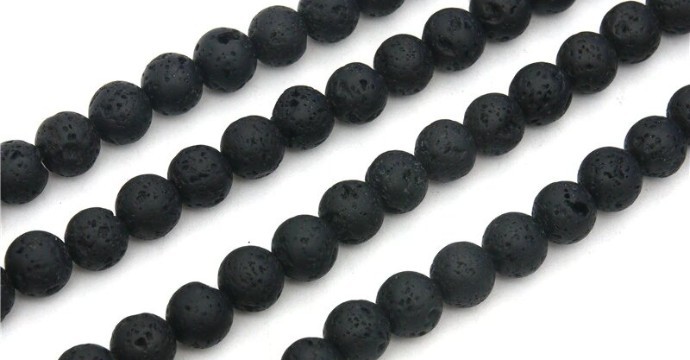
Lava stone is a natural stone derived from the cooled lava of volcanoes, and is very common throughout the world. Lava stone has been associated with lithotherapy since the dawn of time. Today, its use remains highly appreciated in the world of lithotherapy for its soothing benefits, and in the world of jewelry.
Some use it as a natural essential oil diffuser, others for its natural and beneficial properties...
History of Lava stone
Lava stone or Basalt owes its name to the Latin "basalte" meaning "rough stone". Other origins include "basanos" from Greek, meaning "rough stone", or "bsalt" from Ethiopian, meaning "cooked".
Lava stone is a very ancient natural stone, dating back thousands of years; it comes from volcanic eruptions, and is both powerful and terrifying. Men have given it the symbolism of the power of the world, while at the same time reminding us of man's fragility. In this way, Lava stone reminded us of divine wrath, and has been linked to numerous legends.
In ancient times, the Romans used Lava stone as a talisman to protect themselves from evil spirits and bring strength and courage.
Over time, Lavas tone has been used for a variety of purposes, starting with its virtues in lithotherapy as far back as antiquity.
Later, Lava stone was used for its robust qualities, which were used to build monuments such as cathedrals during the Middle Ages, like the Notre-Dame de l'Assomption cathedral in Clermont-Ferrand.
Last but not least, it has been discovered that this natural stone has the ability to absorb and retain heat, which is why it has been used in the manufacture of barbecues. What's more, this stone is also appreciated for its beauty, and is used for decorative purposes as well as in garden centres.
Origin and composition of Lava stone
Lava stone belongs to the Silicate family. This natural stone is composed of plagioclase feldspar, augite, pyroxene, olivine and other minerals such as titanium, magnesium and manganese. Because of its complex and diverse composition, there is no single chemical formula for Lava stone. Its composition varies according to the type of material in fusion at the time of eruption, and also according to the type of volcano from which it came. The density of the stone is between 2.5 and 3.
According to rock classification, Lava stone is an igneous rock. Lava stone is formed from cooled lava that has flowed out of volcanoes. During an eruption, these magma flows reach temperatures of up to 700-1000°C and gradually cool on contact with air, giving rise to rock formations known as magmatic tuffs. The most common is known as basaltic lava, which emerges during a cooling process at certain points (elevation or water) inside a volcano, triggering eruptions if not interrupted in advance. Because of its low silica content, normal volcanoes, such as the Kilauea effusion system in the Hawaiian Islands, exclusively produce such rock formations.
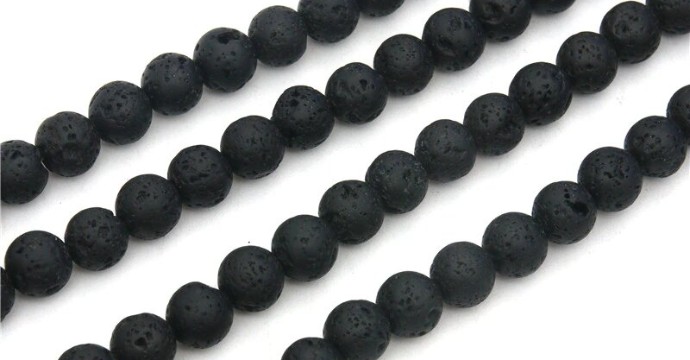
There are several varieties of Lava stone, all different depending on different factors. Nevertheless, the stone remains predominantly black to grey, but depending on certain inclusions the Lava stone may contain white spots.
Origin of Lava stone
The main deposits of Lava stone are found all over the world, on oceanic islands, continental volcanic arcs and in countries such as Italy, Silicia, Ethiopia and Japan.
Lava stone has a hardness of around 5.5 to 6 on the Mohs scale.

Virtues and significance of Lava stone in lithotherapy
In lithotherapy, Lava stone is a stone of protection and healing.
Lava stone in lithotherapy
On a physical level, Lava stone is known for its soothing properties in lithotherapy. Ideal for athletes, this stone can relieve muscular and nervous tension, and strengthen the body and organs for better body function. But this natural stone also benefits women seeking to improve their fertility and people with digestive problems. Lava stone helps fluidify transit. Finally, it is capable of bringing warmth and strength.
On the mental level, Lava stone has the ability to influence the person in a good state of mind, such as greater self-confidence, strength and courage, and above all, not being afraid of change. In lithotherapy, natural Lava stone is an anchoring stone that soothes and protects against negative energies, particularly anxiety. This stone is naturally close to fire, bringing serenity and balance to body and mind for a greater sense of well-being.
What's more, Lava stone is a natural essential oil diffuser: simply place a few drops in the holes in the stone, and it will bring good energy and relaxation throughout your home.
Please note that lithotherapy is not a substitute for medical treatment or expertise.
Significance of Lava stone
Lava stone symbolizes vitality and fire.
This stone is linked to the root chakra to increase self-confidence and vitality, but also brings calm, security and stability.
Lava stone is also linked to the solar plexus chakra, which strengthens vitality and the digestive system, bringing determination and dynamism.
This natural stone is very neutral and, like Rock Crystal, is very close to all astrological signs.
Care, purification and recharging Lava stone
To care for your Lava stone, we suggest a few methods:
Cleaning and purifying Lava stone
It's important to thoroughly clean and purify your Lava stone once it's in your hands:
- Clean the stone in clear, lukewarm water for about ten minutes,
- Purify it by placing it in salt for a short time. However, this method is not recommended for long-term use, as it is porous and can damage the stone.
Recharging Lava stone
Don't forget to recharge your Lava stone to take full advantage of its powers:
- Recharge Lava stone with sunlight for a few hours - direct sunlight is not a problem,
- Recharge it with lunar rays for an hour,
- Recharge it by placing a cluster of quartz next to it,
- Bury the stone in the ground for an hour to recharge it.